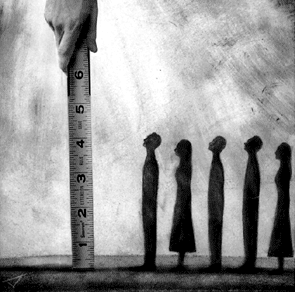
The following is an essay I wrote for a class that ended today. It was one of those classes that makes you think and question everything you thought you knew. I credit the professor for setting up a class where rich conversations occurred, question were asked, and answers were found...sometimes. It was a great time with great people.
A Rainbow - Colored Curriculum
Who am I and what are my core values
and beliefs? If John Gardner’s saying, “we teach who we are” is true, then this
question is worth some serious consideration. If I were to write an equation
for myself it would look something like this: mom,
wife, sister,
daughter, family
member, friend, religious,
learner, human
rights supporter and occasional activist, teacher,
reader, writer,
musician, world
traveler, adventurer, anthropologist, archaeologist,
artist, depression/anxiety
survivor, perfectionist = Emily Rae Echols Tomkins the Eternal Optimist. I
am a rainbow of beliefs and experiences. These facets of my existence provide
the multi-colored happy lenses through which I tend to view the world. As a
result, these aspects of who I am cannot be sieved out before I enter the
classroom — nor would I want them to be. The human experience (my human
experience) provides a depth to the learning that occurs in my classroom
because consciously and unconsciously, it colors every educational choice that
I make, from how I relate to others to decisions regarding curriculum.
My long-term vision for my students
sees them interacting in their communities as fulfilled, thoughtful, caring,
empathetic adults who tend to make the world around them a better place. On
some level, I realize that this is purely selfish. I didn’t really care about
the self-fulfillment of others until I became a mom. I cared about people and
valued kindness, but my own development and happiness was priority number one.
Having a child fractured the insulation of my selfishness; it was only then
that I realized the world needed to be a better place and that I had a moral
obligation to help move it in that direction. At the time, I was a retail
manager leading an unfulfilled existence, unable to change the world in any
meaningful way. As a mother, this became unacceptable. I had to make the world
better for my child and live my own life as an example of a life worth living –
I chose to become a teacher.
My role as a teacher allows me to
help children develop their individual, unique potentials and hopefully become
self-fulfilled as a result. I believe human development and fulfillment occur
through a variety of learning processes. Self-reflection, creative expression,
problem-solving, playing, and communicating are just some of the learning paths
that foster growth, development, and self-fulfillment. On a day-to-day basis I
try to implement curriculum choices to promote the kinds of learning
experiences that lead to the realization of these goals while also meeting individual
learning needs.
I
started the year having my students respond to guided reading books by
answering questions. They had all week to get their responses done and could
choose from a variety of questions to answer. I felt I was moving in the right
direction because my students weren’t limited to a specific format, they didn’t
have to respond in writing to everything they read, and they had more choice in
the types of questions to which they responded. But as time went on this
routine began to feel static and uninspired. My own love for reading is such
that I can’t imagine a life without books. Was I really developing that same
kind of love for my students? The answer was “no.” I started thinking about ways
that I could increase the level of student engagement and make reading more
dynamic. I realized that my approach was limited to written responses so…
I decided to experiment.
I asked the students in one of my guided reading groups if they would like to do
something different. We were reading a book about foods that had been created
by accident and I asked the kids if they would like to “accidentally” create
their own new foods as a kind of response. Their levels of engagement went
through the roof! They were talking about their book outside of guided reading
times, discussing their ideas for food creations, and thinking through problems
encountered during the process. I could see many other students in the class
peeking at this group surreptitiously while trying to maintain the illusion of
independent reading. Many students came up to me later and asked if their group
could do that, too. The answer, of course, was “YES!”
We
moved on and never looked back. One group responded to a “How To” book about
drawing by drawing pictures and explaining the strategies they had learned from
the book. Another group worked together to write and perform a play based on a
book they’d read together. One group created a video summary of The Whipping
Boy. Yet another group designed and created new forms of transportation
using toys and diagrams. I was also changed as a teacher in that I had to rely
more heavily on those rich conversations as a method for assessing student
understanding. It forced me to hone my listening skills as students spoke
because I couldn’t simply go back and read their responses later.
In our conversation with Peter
Johnston, he mentioned that no matter what the grade level, he felt the key to
reading was the engagement factor for students (personal communication, July
17, 2013). Based on my own experiences in the classroom, I have to agree with
his assertion. When students are engaged in the learning process, you can feel
it; you can see it on their faces and in their body language — it’s a wonderful
experience. This is the ideal toward which we strive. It is easier to believe
in these ideas during the summer, removed from the daily grind and the unholy
pace of the school year.
During
the school year, it is too easy to get caught up in the assessment/accountability
factor. Am I going to have enough grades for infinite campus and report cards?
Do my grades actually reflect what my students know and can do? Do I have
student examples for conferences? Can I show growth for this student over the
course of the year? Are my kids prepared for the Dakota Step? I’m not saying that teachers should stop assessing
students. Assessment, whether diagnostic, formative, or summative has a
valuable role to play in providing an education tailored to meet individual
needs in a timely manner. But perhaps we need to be more thoughtful in how our
students are assessed and how those assessments are reported. Darling-Hammond
(2009) notes that, "According to the FNBE, [Finnish
National Board of Education] the main purpose of assessing students is to guide and encourage students’ own reflection and self-assessment. Consequently, ongoing feedback
from the teacher is very important. Teachers
give students formative and summative reports both through verbal and narrative feedback." (p. 21)
In
a sense, as I try to design a language arts curriculum that truly engages my
students and opens their minds to growth and possibility, it is equally
important that I open my own mind to what constitutes assessment and shows
growth.
I need to give myself the freedom to
move away from a heavy reliance on written assessments that test each student
individually. In focusing on the number of grades, as opposed to the quality of
thinking required by those graded assignments, I may have unwittingly narrowed
my curriculum to concepts and facts that are easily assessable — facts as
opposed to critical thinking. Peter Johnston (2012) points out that,
most conversations about schooling
work from the assumption that a curriculum is a bunch of certain facts to be efficiently delivered to the
students, and that a teacher’s problem
is to deliver the true facts so that they stick, are well organized, and can be
assessed. (p.59) I
feel as though I’ve been mired in the world of black-and-white test taking for
so long, first as a student and then as a teacher, that my own comfort level
with assessment and giving grades now resides firmly in the land of easily
assessable answers.
While I have little control over the
high-stakes testing imposed upon my students by the state, my own assessments
and graded materials can, and should strive to promote self-reflection,
critical thinking, reasoning, and problem-solving. As I approach the new school
year, this is one aspect of the curriculum that I want to constantly evaluate.
I believe using the backward design approach will help ensure that my
assessments promote higher levels of thinking rather than supporting a
regurgitation of the facts. This type of design demands, “that
we think about a unit or course in terms of the collected assessment evidence
needed to document and validate that the desired learning has been achieved,” (Wiggins
& McTighe, 2005, p.18).
My own personal experiences provide a colorful background
for how and what I teach. My love of reading, and a desire to instill that love
in my students, leads me to constantly strive for meaningful student engagement
with literature. I want my students to question, think, defend their ideas, and
be willing to change their opinions when presented with new information. These
desires stem directly from my training as an anthropologist. And yet, as is
evident, these same experiences have led me to view assessment in a very narrow
manner. Yes, we teach who we are, but as self-reflective practitioners, we also
strive to understand how our own experiences color our choices, for better or
for worse, and work constantly to improve the very personal art of teaching.